

What AI visibility does your visitor attraction have - and what to do if you don’t like it?

Just like we ignored TikTok for a while and hoped it would go away and it didn't, we've accepted that AI is here to stay and we need to our tourism businesses and days out to be visible.
A Q&A with Catherine Warrilow, founder of The Plot, on why AI search is a commercial risk for visitor attractions right now - and why it’s easier than you might think to educate the LLMs that are speaking to customers on your behalf.
When there's a conversation happening about your attraction, experience or tour, you want to feel confident that an AI assistant or AI search result is painting the right picture of what you have on offer. And worse, you want to ensure you’re not left off the list of recommendations. We know that people don't open Google and scroll ten blue links any more. They ask Claude or Gemini, or the AI summary sitting at the top of the search page: "where should I take the kids near York this weekend? And make sure you suggest somewhere buggy-friendly and near to some nice cafes and parks".
I listened to a talk by Ailish English, Industry Head for Travel at Google at the latest Travolution Connects event recently and she said that Google are still seeing 5 trillion searches a year - and that number is growing. Travel searches are up by 10% YoY. What’s changing is the length and depth of the search query. AI has taught us to become far more conversational in our requests and prompts.
The most important question for me is, when someone asks an LLM or a search engine a question like this, does it include you? And if not, why not?
I get asked about AI a lot - it feels faddy and over hyped to many. To others it feels like one too many things to conquer. Others are tackling the basics but don’t have the time or energy to go deeper.
I’m in the process of putting together some video content but for now, I sat down and answered the questions attraction marketers are most interested in- well, in honesty, I took all the questions you’ve asked me so far and asked Claude to interview me. So here goes.
Everyone's talking about AI. Why do you say it's a risk right now, for visitor attractions?
Because consumer behaviour has already changed. Your visitors are already asking AI assistants and AI assisted search to make the decision for them, or at least give them a short list. Then, rather than going and doing their own research, they’re asking more questions - “if we do decide to go to The Tank Museum, is there a cafe? Is parking free? And will it be appropriate for our 7 year old?”.
I asked an industry peer recently about their perspective on AI use and they were quite matter of fact - “all I see is pretty bad examples of people using AI to create marketing content - it’s a no from me”.
And I agree - using AI to generate images when we are in the business of creating truly extraordinary moments and seeing actual smiles on actual faces - if we can’t capture real UGC then there’s a bigger problem at hand.
What I’m talking about with AI is telling your story and aligning your ducks in a way that allows AI to do this:
Is the visitor attraction relevant to the users search query? And how many of the questions they’ve included can I answer?
Can I find information that validates these answers - social proof, reviews, authority?
Can I find a start, a middle and an end - the ‘home’ of the attraction eg their website, the FAQs eg geographical location, pricing, accessibility - and can I tell the user how much a ticket costs and how to book.
As a visitor attraction marketer, whether you’re using AI tools for very basic tasks like “tell me which of these family day out Facebook groups is the biggest and most engaged” or “proof read the email newsletter for me and tell me what you think the core CTAs are”.
Right through to the complex “build me a commercial dashboard that models our projected visitor footfall vs average ticket price vs retail spend vs upsell vs seasonal peaks and dips” - the opportunities to run a much smarter operation are pretty endless - and look a bit like this.
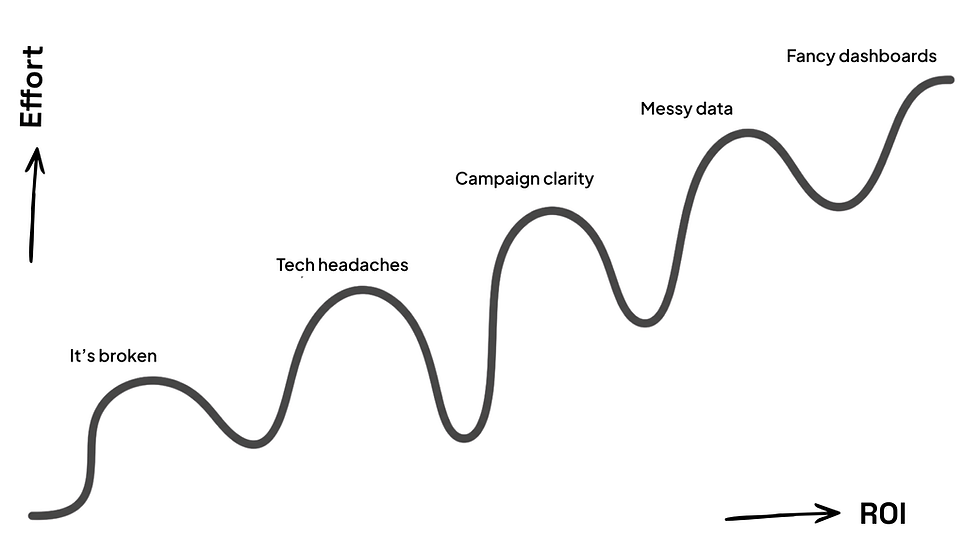
But for now, on with the questions about AI visibility - because if you haven’t cracked that, you’re jumping over the most vital step.
What does "being invisible to AI" actually look like?
It looks like an answer that doesn't include your attraction when it absolutely should because you are relevant to the search query. Someone asks for the best rainy-day attraction within an hour of home, and three of your competitors get named and you don't - not because you're worse, but because AI couldn't find a clear, consistent, well-structured reason to mention you.
Or worse than invisible: wrong. The opening hours it quotes are last year's. It describes you as a "small local museum" when you've spent two years and a serious budget becoming a one-of-a-kind interactive, 3D, immersive super-dooper museum. AI is happily telling thousands of people a version of you that you retired ages ago. You wouldn't let a member of staff stand at the gate saying that. But you're letting the algorithm do it, because you didn't know it was still finding information from 2021 over and above anything more recent.
How do I even find out what AI says about me?
You ask it. Simple as that - that's step one, and it costs nothing. Open Claude or Gemini and ask the questions your visitors would actually ask. When I do a client review I do this exercise with at least 4 or 5 - usually Claude, Gemini, ChatGPT, CoPilot, Perplexity and one other.
Not "tell me about [your attraction]" - that's not going to give you anything of value. Ask the real ones: "best family day out near [your town]," "things to do near [landmark] when it's raining," "is [you] worth visiting with toddlers?"
Then read what comes back the way a stranger would. Are you there? Is it accurate? Is it flat, or does it actually make you sound like somewhere worth choosing? Most people do this for the first time and go quiet for a minute. It's the same feeling as reading your own TripAdvisor reviews properly for the first time - uncomfortable, and the most useful thing you'll do all month.
Give all of the results across all of the LLMs to your AI of choice and ask them to audit the responses. Then start digging deeper into why you’re absent from some of those results.
Everyone's using AI to write their content now. You push back on that. Why?
Because using AI to do the thinking is where it falls apart. AI is brilliant for structure, for getting unstuck, for turning your messy notes into a first draft at speed. I use it every day. But the moment you hand it the actual insight - the judgement about who your visitor is, what they're really there for, the nuance in the detail - you get beige. You get the safe, mainstream, sounds-like-everyone version. And you stop learning - if AI is reading the insights and not you, regardless of how quickly and easily it summarises them all and creates you 17 social posts, you’re going to miss invaluable insights.
Like any tool or technology you have to learn how to use AI - how to work with it. I cannot tell you how many hours, days and weeks I’ve invested and how much I’ve learnt over the last 6 months. AI as a thinking partner is genius - but you should always remain in the driving seat. AI is the navigator. Like I said, I use AI all day every day to help speed up clunky admin tasks, or arrange data in a meaningful way. It frees more of my time to spend on the tasks that I want and need to do - writing and creating content is part of that.
Another comment from Travolution Connects was around where AI sits in the customer journey. And the room was in agreement that AI has transformed the research part of the process, but does not, and likely cannot own inspiration or anticipation - that comes from real life content and human conversation and connection. I agree entirely.
So where does an attraction marketing team actually start?
With the question: what problem does my visitor actually have, and does AI describe us as the answer to it? You're not trying to "do AI." You're trying to make sure that when a real person, in a real moment of deciding, asks for help that you're the obvious answer, told accurately, in language that sounds like a reason to come.
Practically: check what AI says about you today. Fix the basics it's getting wrong - your hours, your offer, your structured information. Get consistent about who you're for, everywhere, so the machine has something clear to repeat. And stop reinventing your message every fortnight - consistency is what AI rewards, the same way it's always been what humans remember.
I always used to be guilty of that - changing things up all the time because I was bored - yet the customer has barely just noticed the last post you put out there. The last Ideas Fest event I went to included a lot of talk about repetitive content being a positive and I agree - don’t change everything, stick to your core messages and just add new flavour, seasonality or relevance depending on the situation.
A few places to start with creating consistency would be your social media profiles, key details across your website vs OTAs and partner sites, your wider FAQs and your schema mark up.
Get busy!
And if we just… don't?
The world is not going to end. Your visitors are not going to vanish. And ultimately, the time you invest has to tie back to your wider strategy and goals. If you started using TikTok for a specific reason, and you’re using it strategically to reach a certain audience, then tackle AI visibility with the same mentality. What are you trying to do here? Reach customers over a certain distance away that don’t know about you? Make your experience more accessible to inbound visitors? Start with the problem you’re trying to solve.
With AI, you don't get a bounced email or an abandoned basket to tell you something went wrong. The visitor just gets pointed somewhere else, has a lovely day, and never knew you were an option. No data, no signal, no second chance. That’s really annoying.
If you want to chat more about simple things you can do today to create better AI visibility for your visitor attraction, experience or tour, then my inbox is always open so come and say hi or ask for more information about what an AI visibility audit for your experience might look like.


Comments